

Velatropa24Ventures CO
In a hurry? Start here !
Problem
V24V lacked longitudinal understanding of crypto trust and behavior, limiting product decisions for sustained adoption.
Insight
Trust fluctuates with emotion, perceived control, and transparency - users need clarity at every step, not just a usable interface.
Impact
Delivered a 7-week diary + interview study that surfaced adoption barriers and trust drivers, informing onboarding, education, and ecosystem design priorities.
Want the details? Here you go!
Background
A longitudinal UX research project exploring crypto adoption, trust, and emotional behavior over time.
Velatropa24Ventures CO (V24V) is an arts-science research organization building a decentralized ecosystem that brings together artists, technologists, and innovators through experimental economic models, community governance, and digital products in the Web3 space.
For this project, I led a 7-week longitudinal UX research study to understand how users experience crypto over time - focusing on trust formation, emotional responses, social influence, and barriers to sustained adoption - to inform future product, onboarding, and ecosystem decisions.
Role
UX Researcher
Responsibilities
User Interviews, Diary Studies, Data Synthesis
Tools
Google Meet, Google Forms, Miro, Jira, AI Tools
Duration
16 weeks
Problem
V24V was exploring how individuals experience cryptocurrency beyond first-time use, but lacked a clear understanding of how trust, emotions, and behaviors evolve over time.
Most existing insights around crypto adoption focus on one-time interactions, price speculation, or surface-level usability, which fail to capture:
Long-term trust formation
Emotional highs and lows
Social and cultural influences on adoption
Barriers that prevent sustained, confident usage
Without longitudinal insight, it was difficult for V24V to make informed decisions around onboarding, transparency, education, and ecosystem design.
Design Goals
What we wanted to understand
Understand Behavior Over Time
Move beyond one-time interviews to observe how users’ perceptions, confidence, and behaviors around crypto change across weeks of real usage.
Uncover Trust & Emotional Drivers
Identify how trust is built or lost, and how emotions such as excitement, fear, or gambling-like behavior influence decision-making.
Identify Adoption Barriers
Surface friction points related to fees, complexity, transparency, and mental load that prevent continued engagement.
Inform Product & Ecosystem Decisions
Translate research findings into actionable insights to guide future product features, onboarding flows, and community-driven initiatives within the V24V ecosystem.
Research Planning
Designing the Research Journey
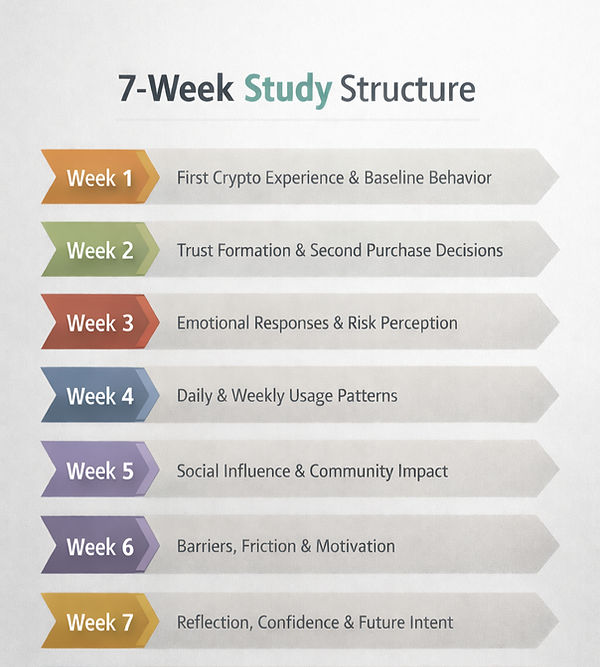
To capture how crypto perceptions and behaviors evolve over time, I designed a 7-week longitudinal study, with each week focused on a specific theme.
The weekly topics were defined upfront and approved by stakeholders, allowing for consistency while still leaving room to probe emergent insights.
Each week included:
-
A focused research theme
-
A set of semi-structured interview questions
-
Diary prompts aligned to real-world crypto usage
-
This approach ensured that insights built progressively across weeks rather than remaining isolated observations.
For each week, I created targeted interview questions and diary prompts tailored to the week’s theme.
Questions were designed to:
-
Encourage reflection on real behaviors, not just opinions
-
Surface emotional drivers alongside functional pain points
-
Build on insights from previous weeks
This iterative question design helped uncover shifts in mindset, trust, and usage patterns over time.
Recruitment & Ethics

Choosing the Right Voices
Participants were recruited using a Google Form screener circulated through online communities and referrals.
Responses were reviewed and shortlisted based on predefined criteria to ensure relevance, diversity, and long-term commitment.
All participants were informed about the study’s purpose, data usage, and interview recording in advance.
Consent was obtained prior to participation, and confidentiality was maintained throughout the study.
Participants were compensated for their time, ensuring ethical and transparent research practices.
Conducting the Study
Following Participants Over Time
After shortlisting 12 participants, I began conducting weekly remote interviews over Google Meet.
Each week focused on a different research theme, allowing conversations to build progressively over time.
At the end of every week:
-
Participants completed a diary study reflecting on their real-world crypto usage
-
Prompts were aligned with the week’s topic to capture both behaviors and emotions
This cycle of interviews + diary entries continued for 7 weeks, enabling observation of shifts in trust, confidence, and usage patterns across time.
To protect participant privacy, all names and identifiable responses have been anonymized in this case study.
Data Synthesis & Analysis
Finding Meaning Across Weeks
After each weekly interview and diary submission, I conducted ongoing analysis rather than waiting until the end of the study.
This allowed patterns to emerge early and informed follow-up questions in later weeks.
To make sense of large volumes of qualitative data, I used a color-coded thematic approach to organize and synthesize insights:
-
🟥 Pain Points - friction, confusion, distrust, and barriers
-
🟩 Motivations - drivers, values, confidence, and positive signals
-
🟦 Opportunities - unmet needs, ideas, and potential product directions
This approach helped surface recurring themes across participants and weeks, while also highlighting shifts in emotions, trust, and behavior over time.
Insights were continuously refined across weeks, allowing earlier findings to shape later interviews and diary prompts.

Key Insights
Following Participants Over Time
Confidence grows with familiarity
Repeated exposure and real-world use mattered more than formal education.
Crypto feels emotionally like gambling
Participants described emotional highs, losses, and thrill-driven decisions.
Trust comes from people, not platforms
Friends, family,& online communities influenced adoption more than institutions.
Mainstream online, rare offline
Limited real-world usage slowed everyday adoption and confidence.
Fees create mental friction
Hidden and unpredictable costs discouraged frequent transactions.
Participant Snapshots
Representative perspectives that highlight different crypto mindsets observed during the study.
The Optimistic Adopter
Mindset: Future-oriented, confident, growth-driven
“Crypto feels like the future of finance, not just an investment.”
-
Sees crypto as long-term innovation
-
Motivated by success stories and early wins
-
Confidence increased steadily over time
The Cautious Realist
Mindset: Risk-aware, analytical, fee-sensitive
“The risk and thrill are part of crypto, but fees and volatility matter.”
-
Sees crypto as long-term innovation
-
Motivated by success stories and early wins
-
Confidence increased steadily over time
The Stability-Focused User
Mindset: Practical, safety-driven, utility-focused
“Crypto only feels useful when it works in real life.”
-
Values stability and real-world use cases
-
Skeptical due to scams and complex interfaces
-
Wants stronger connections between banks and crypto wallets
Design & Product Direction
Decisions shaped by longitudinal research findings.

Direction 01 - Reduce Emotional Risk
Why
Participants described crypto as emotionally intense, often resembling gambling behavior.
Direction
Design experiences that slow users down through risk cues, reassurance, and loss-prevention guidance.
Direction 02 - Make Trust Visible
Why
Trust was shaped more by peers and communities than by platforms themselves.
Direction
Surface social proof, transparency indicators, and community signals to support informed decision-making.
Direction 03 - Normalize Everyday Use
Why
Crypto felt mainstream online but lacked real-world presence and utility.
Direction
Support everyday payment use cases and highlight real-world adoption to increase confidence.
Outcomes & What’s Next
Impact
-
Established a longitudinal understanding of crypto adoption, trust, and emotional behavior over time
-
Identified key behavioral patterns influencing confidence, risk perception, and usage
-
Informed product, onboarding, and trust-building direction within the V24V ecosystem
Next Steps
Research
-
Expand the study to a larger and more diverse participant group
-
Validate findings through usability testing and concept evaluation
-
Test trust-building and fee-transparency features with users
Product
-
Translate research directions into early design concepts
-
Prototype onboarding and transparency improvements
-
Move from research → design → iterative implementation